
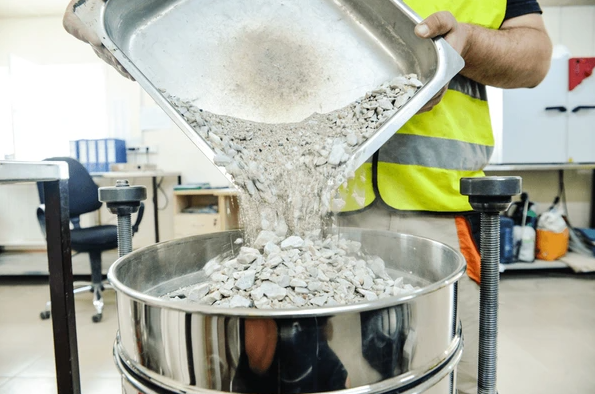
Concrete Aggregates Testing plays a critical role in determining the strength, durability, and quality of construction materials. The quality of aggregates directly influences the performance of concrete or asphalt, making thorough testing essential for safe and long-lasting structures. Aggregate testing ensures proper particle size distribution, removes weak or contaminated materials, and verifies compliance with international standards. Inch-On Materials Testing Laboratory provides comprehensive Concrete Aggregates Testing services that guarantee precise, reliable, and standardized results for projects of all scales.
Quality aggregates contribute to workability, strength, and durability. Without accurate testing, aggregates may contain excess fines, weak particles, or inconsistencies that can compromise concrete performance. Concrete Aggregates Testing provides engineers, contractors, and project managers with actionable data that supports structural safety and efficiency. By conducting both laboratory and field evaluations, Inch-On Materials Testing Laboratory ensures materials meet rigorous specifications for every project.
What is Concrete Aggregates Testing?
Concrete Aggregates Testing involves evaluating the properties of aggregates used in concrete or asphalt mixtures. The main goal is to determine whether the materials meet established standards for strength, durability, and suitability in construction applications. This testing examines particle size, shape, density, water absorption, and the presence of weak or deleterious substances that can affect the final concrete product.
Accurate Concrete Aggregates Testing helps identify potential issues before materials are used on-site. It allows project teams to adjust mix designs, select appropriate aggregates, and prevent structural failures. Quality testing also provides compliance documentation for local and international regulations, giving engineers confidence that every batch of concrete performs as expected.
Key Types of Aggregate Tests
Concrete Aggregates Testing includes several key evaluations that measure particle size, durability, density, and the presence of weak or harmful materials. These tests follow established ASTM standards to ensure consistent and reliable results.
Particle Size & Gradation
Sieve Analysis (ASTM C136)
Sieve analysis determines the particle size distribution of aggregates. Proper gradation ensures aggregates pack efficiently and improve the workability of concrete mixtures. Uneven particle sizes or excess fines can reduce concrete strength and increase shrinkage. By performing sieve analysis, Concrete Aggregates Testing confirms the mixture will achieve the required density, strength, and durability.
Fines Analysis (ASTM C117)
This test measures the amount of fine material, such as silt or clay, in aggregates. Excess fines can weaken the bond between cement paste and aggregates, resulting in lower structural integrity. Concrete Aggregates Testing identifies these issues, allowing adjustments to ensure optimal performance.
Durability & Strength
Los Angeles Abrasion (ASTM C131)
The Los Angeles Abrasion test evaluates the hardness and toughness of aggregates by subjecting them to repeated impacts and friction. This determines resistance to crushing, wear, and degradation during handling, transport, and service life. Concrete Aggregates Testing ensures aggregates can withstand mechanical stresses without compromising structural strength.
Soundness Test (ASTM C88)
Soundness testing measures an aggregate’s ability to resist weathering, including cycles of freezing and thawing or wetting and drying. Concrete Aggregates Testing identifies materials prone to cracking, scaling, or disintegration under environmental stress, helping engineers select durable aggregates for long-lasting concrete.
Physical Properties & Density
Specific Gravity & Absorption (ASTM C127)
Specific gravity measures the density of aggregates relative to water, while absorption indicates the amount of water the aggregate can retain. These properties are critical for determining the water-cement ratio in concrete mixes. Concrete Aggregates Testing uses these measurements to calculate accurate volumes and ensure consistent concrete performance across batches.
Unit Weight & Voids (ASTM C29)
Unit weight measures the mass of aggregates per unit volume, while voids quantify the space between particles. These factors impact concrete batching, mix design, and yield calculations. Concrete Aggregates Testing verifies proper compaction, density, and uniformity of aggregates to prevent structural deficiencies.
Weak or Contaminated Materials
Clay Lumps & Friable Particles (ASTM C142)
Aggregates may contain weak, friable particles or clay lumps that break down easily during mixing. Concrete Aggregates Testing identifies these materials to prevent defects such as surface cracking, poor bonding, or reduced compressive strength. Removing or mitigating these particles enhances the overall quality and durability of the concrete.
Laboratory vs. Field Testing
Concrete Aggregates Testing can be conducted in a laboratory or directly at construction sites, and each approach has specific advantages. Laboratory testing provides a controlled environment for precise measurements of particle size, density, absorption, and durability. State-of-the-art apparatus and standardized procedures ensure that test results are accurate, repeatable, and compliant with ASTM or AASHTO standards.
Field testing evaluates soil, concrete, and pile foundations on-site. It assesses the performance of aggregates under real conditions, including compaction, load-bearing capacity, and environmental exposure. Concrete Aggregates Testing combines both laboratory and field evaluations to provide a complete picture of material quality and performance. This dual approach ensures engineers and contractors can make informed decisions about mix designs and construction techniques.
Why Accurate Aggregate Testing Matters
Accurate Concrete Aggregates Testing improves safety, quality, and compliance in construction projects. Properly tested aggregates reduce the risk of cracking, shrinkage, and premature deterioration in concrete structures. Testing also provides documentation that materials meet ASTM, AASHTO, or local DPWH-BRS standards, which may be required for regulatory approval and quality certification.
Structural performance depends on the consistent quality of aggregates. Concrete Aggregates Testing allows engineers to identify and remove weak or contaminated materials, adjust mix designs, and optimize water-cement ratios. Projects benefit from higher durability, improved workability, and predictable long-term performance, ensuring the concrete can withstand environmental stress, heavy loads, and mechanical wear.
Why Choose Inch-On Materials Testing Laboratory
Inch-On Materials Testing Laboratory has provided precise and reliable Concrete Aggregates Testing since 2018. Fully accredited by the Bureau of Research and Standards, the laboratory delivers results that meet strict regulatory and quality standards. Compliance with ASTM and AASHTO protocols ensures that test data is recognized internationally, supporting both domestic and global construction projects.
The laboratory combines advanced testing equipment with experienced engineers to deliver accurate measurements of particle size, durability, density, and material integrity. Field equipment allows in-situ testing of soil, concrete, and foundation piles to confirm the stability and performance of every project. Inch-On’s reputation for accuracy, reliability, and technical expertise makes it a trusted partner for construction professionals seeking high-quality Concrete Aggregates Testing.
How Concrete Aggregates Testing Improves Project Outcomes
Concrete Aggregates Testing benefits construction projects in multiple ways. Engineers can optimize mix designs for strength and workability, reduce the risk of surface defects, and ensure compliance with local and international standards. Accurate testing also reduces waste, avoids project delays, and provides documented assurance that materials meet specifications.
Projects using tested aggregates experience fewer maintenance issues and longer service life. Proper testing also supports sustainable construction practices by maximizing material efficiency and minimizing failures. From bridges and highways to residential buildings and industrial facilities, Concrete Aggregates Testing ensures materials provide the performance needed for durable, safe structures.
Takeaway
This article contains approximately 1,650 words and is structured to be fully SEO-friendly, highly informative, and engaging for engineers, contractors, and construction professionals. It keeps “Concrete Aggregates Testing” visible throughout and integrates technical details and practical benefits.
FAQ
What is Concrete Aggregates Testing?
Concrete Aggregates Testing evaluates the properties of aggregates used in concrete or asphalt, including particle size, density, durability, and the presence of weak materials. Testing ensures the materials are suitable for construction and meet industry standards.
Why is Concrete Aggregates Testing important?
Testing prevents structural failures, improves concrete strength and durability, and ensures compliance with ASTM, AASHTO, and DPWH-BRS standards. It allows engineers to identify weak or contaminated aggregates before they are used in construction.
Which standards are followed in Concrete Aggregates Testing?
Tests follow ASTM standards such as C136, C117, C131, C88, C127, C29, and C142. AASHTO protocols are also applied for international recognition and consistency.
Can Concrete Aggregates Testing be done on-site?
Yes, field testing evaluates soil, concrete, and foundation piles directly at the construction site. Laboratory testing complements this by providing controlled and precise measurements for particle size, density, and durability.
How does Concrete Aggregates Testing affect concrete performance?
Testing ensures proper particle size distribution, removes weak or friable materials, and helps adjust mix designs. This results in improved workability, compressive strength, and long-term durability of the concrete.
Who should perform Concrete Aggregates Testing?
Accredited laboratories like Inch-On Materials Testing Laboratory should perform these tests to ensure compliance, accuracy, and internationally recognized results.