Soil is one of the most important materials supporting a construction project, even though much of it remains hidden beneath the finished structure. Before a building, road, pavement, or other facility can perform as intended, the soil beneath and around it needs to provide appropriate support and stability. This is why In-place density soil Philippines testing is an important part of construction quality control. Field density testing allows professionals to evaluate soil in the condition in which it exists at the construction site. Instead of relying exclusively on laboratory measurements, engineers and contractors can obtain information about actual field conditions. The results can help determine whether compacted soil has achieved the density required by project specifications.
What Is In-Place Soil Density?
In-place soil density describes the mass of soil contained within a specific volume at its actual location in the field. The measurement can be used to evaluate soil that has been placed and compacted during construction or, where appropriate, soil in its existing condition. Density is commonly considered together with moisture content because water contained within the soil affects its measured weight and dry-density calculation. Dry density is particularly useful when evaluating soil compaction because it focuses on the mass of soil solids relative to volume without including the mass of water. Field density testing therefore provides information that can help construction professionals understand the condition of a particular soil layer.
The concept is especially relevant when a contractor is placing fill material in controlled layers. Each layer may need to be compacted before another layer is added. If the soil is not compacted adequately, the resulting layer may not perform as expected under future loads. A field density test can provide measurable evidence of the condition of the compacted material. This makes In-place density soil Philippines testing valuable for construction projects where soil performance is an important part of the overall design. The actual testing procedure should be selected according to the soil characteristics, project specifications, and applicable testing requirements.
Why Soil Density Matters to Construction Projects
Properly compacted soil can provide a more stable platform for construction activities. It can help reduce the amount of air voids within the soil and improve the consistency of a prepared layer. Roads, parking areas, building sites, embankments, utility trenches, and other projects may depend on controlled soil compaction. When inadequate compaction occurs, the material may be more susceptible to settlement or deformation when subjected to future loading. These conditions can create concerns for subsequent construction work and may require corrective measures.
Field density testing gives project teams a practical way to check whether compaction work has produced the required result. Visual inspection alone cannot reliably determine the density of soil beneath the surface. Similarly, knowing the number of times a roller has passed over an area does not necessarily establish that the specified density has been achieved. Soil type, moisture, equipment, lift thickness, and operating procedures can all influence compaction performance. Measuring density at representative locations provides quantitative information that can be incorporated into a project’s quality-control process.
How Soil Compaction Affects Density
Compaction uses mechanical energy to rearrange soil particles and reduce air voids within the material. Depending on the soil type, construction equipment may include smooth-drum rollers, vibratory rollers, pneumatic rollers, plate compactors, or other suitable machinery. The effectiveness of the compaction process depends on using equipment appropriate for the material and applying the correct amount of effort. A soil layer that is too thick may not receive uniform compaction throughout its depth. This is why construction specifications often establish requirements for lift thickness, moisture condition, and compaction procedures.
Moisture is another major factor in soil compaction. Adding an appropriate amount of water can help soil particles move and rearrange under compaction energy. However, excessive moisture can also interfere with effective compaction and may produce undesirable field conditions. The relationship between moisture and dry density can be evaluated through laboratory compaction testing. Field density and moisture measurements can then be compared with the appropriate laboratory reference values. This relationship is central to understanding whether compacted soil is performing according to the requirements established for a particular project.
Common In-Place Density Testing Methods
Several methods are available for determining soil density in the field. The method selected depends on the material, site conditions, project requirements, and applicable standards. One established method is the sand-cone procedure, which determines the volume of a test hole using calibrated sand after a measured quantity of soil has been removed. ASTM D1556/D1556M addresses the determination of density and unit weight of soil in place using the sand-cone method. This approach can provide useful field information when the soil and test conditions are suitable.
Another method uses a nuclear density gauge to measure in-place density and moisture. ASTM D6938 covers nuclear methods for measuring in-place density and water content of soil and soil-aggregate materials at shallow depths. (store.astm.org) One advantage of this approach is the ability to obtain measurements quickly without excavating a conventional test hole for every reading. However, nuclear density testing requires suitable equipment, appropriate procedures, and qualified personnel. The testing method should always be selected based on the project’s technical requirements rather than convenience alone.
How an In-Place Density Test Works
The field testing process starts with identifying an appropriate location for measurement. Testing locations may be established through a project’s quality-control plan or determined by the responsible engineer, inspector, or testing professional. The selected area needs to represent the material and construction layer being evaluated. Surface preparation is important because uneven or unsuitable surfaces can affect the measurement. The technician then performs the selected test according to the applicable procedure.
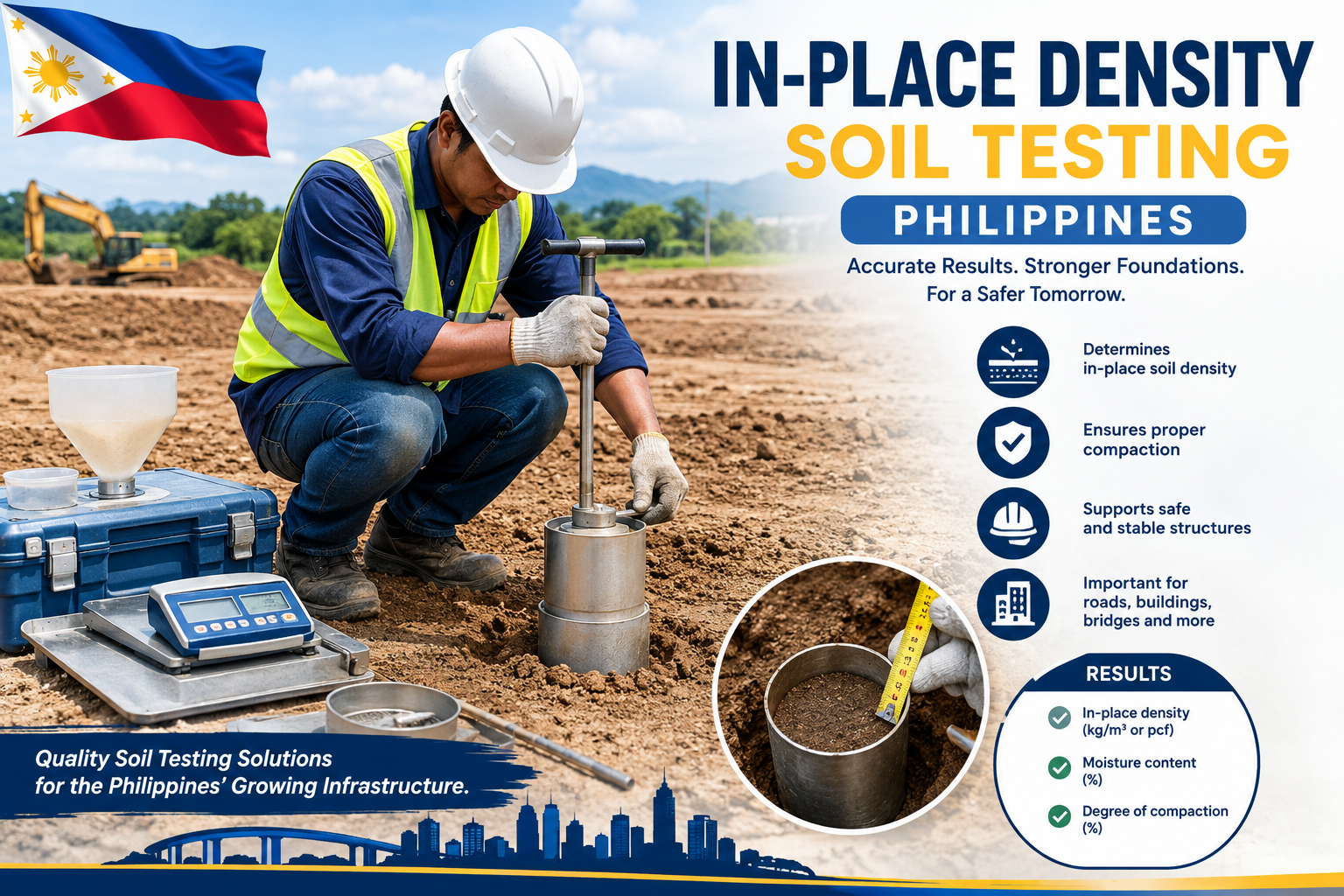
For a sand-cone test, a carefully prepared hole is excavated and the removed soil is collected for measurement. The volume of the hole is determined using calibrated sand, allowing the density of the excavated material to be calculated. For a nuclear density gauge, the equipment is placed and operated according to the applicable testing procedure to obtain density and moisture measurements. The technician records the relevant field information along with the test results. The data can then be evaluated against the project’s applicable laboratory reference and acceptance criteria.
The Importance of Moisture Content
Moisture content has a direct relationship with the way soil responds to compaction. When soil is compacted at an appropriate moisture condition, particles can often move into a more tightly arranged configuration. If the material is too dry, additional compaction effort may not produce the desired result. If the soil is excessively wet, water can occupy spaces that would otherwise need to be reduced through compaction. This makes moisture management an important component of earthwork operations.
Laboratory compaction testing can establish an optimum moisture content associated with a particular compaction procedure. It can also provide a maximum dry-density reference for that material. Field testing then provides measurements from the actual construction area. Comparing these results can help project personnel determine whether the soil was compacted under suitable conditions. The exact interpretation should always follow the project’s specifications and the applicable laboratory and field testing procedures.
Field Density and Laboratory Testing Work Together
Laboratory soil testing and field density testing serve different but complementary purposes. Laboratory compaction testing is performed under controlled conditions to establish reference characteristics for a particular soil and testing method. Field density testing measures what has actually been achieved at the construction site. This difference makes both forms of testing valuable when quality control is required. Laboratory information without field verification does not necessarily demonstrate that construction crews achieved the specified condition.
The field dry density can be compared with the applicable laboratory maximum dry density to determine a percentage of compaction when required by the project. This percentage can then be evaluated against the specified acceptance requirement. The reference value should be appropriate for the soil and laboratory procedure being used. A generic density value should not be applied to every type of soil or construction activity. Engineers and testing professionals should interpret results using the project’s technical documents and applicable standards.
Applications for In-Place Density Soil Testing in the Philippines
The need for field density testing can arise across many types of construction work in the Philippines. Building developments may require testing of compacted fill beneath slabs, foundations, pavements, or other constructed areas. Road construction may involve density testing for prepared subgrade, embankment, or other compacted layers. Site development projects may require numerous tests when large areas are filled and graded. Utility installation projects may also use field density testing to evaluate compacted trench backfill.
The exact testing program varies according to project size and specifications. Large infrastructure projects may establish detailed testing frequencies and documentation requirements. Smaller projects may have different requirements based on the design and scope of work. In every situation, testing should be planned around the material being placed and the construction stage being evaluated. Consistent field testing can provide useful information before subsequent work covers the tested layer.
Factors That Can Influence Field Density Results
Field density results can be affected by several variables, beginning with the characteristics of the soil itself. Granular soils and cohesive soils respond differently to moisture and mechanical compaction. The amount and type of compaction energy can also influence the resulting density. Lift thickness is important because equipment may not compact a thick layer uniformly. Moisture conditions can change throughout a construction site, especially during periods of heavy rainfall or extended dry weather.
The testing process itself also requires careful attention. Equipment should be appropriate for the selected procedure and maintained according to applicable requirements. Personnel need to understand the testing method and follow the required steps consistently. The selected test location should accurately represent the construction layer being evaluated. ASTM documentation emphasizes the importance of appropriate equipment and competent personnel when performing nuclear density testing. (store.astm.org) These factors demonstrate why professional field testing is more than simply obtaining a density reading.
What Low Density Results May Indicate
A field density result below the specified requirement can have several possible explanations. The soil may not have received sufficient compaction energy, or the moisture condition may have been unsuitable. The lift could also have been placed too thick for the equipment being used. Variations in soil material can produce different compaction responses within the same general construction area. For this reason, a low reading should be evaluated within the context of the project’s testing program and construction records.
Project personnel may review nearby results, equipment operation, moisture conditions, material information, and laboratory data. If the result is confirmed to represent an area that does not meet the specified requirement, corrective work may be necessary. Depending on the situation, this could involve additional compaction, moisture adjustment, reworking of the soil, or replacement of unsuitable material. A subsequent field test can then determine whether the corrective work produced the required condition. Decisions about corrective measures should be made by the appropriate project professionals based on the applicable engineering requirements.
Selecting a Reliable Testing Provider
Choosing an experienced testing provider is an important step when a project requires In-place density soil Philippines services. The provider should have appropriate field-testing equipment and personnel who understand the relevant procedures. Construction companies should ask which testing standards and methods are used for their particular project. They should also determine whether the provider can conduct testing at the required construction locations and provide clear documentation. Equipment suitability and personnel competence can directly affect the reliability of field measurements.
Reporting is another important consideration. A useful field density report should clearly identify the project, test location, date, material information, testing method, and measured results. Where appropriate, it should also identify moisture content, dry density, laboratory reference values, and the calculated degree of compaction. Clear reporting allows engineers, contractors, inspectors, and project managers to review results efficiently. A testing provider that understands both field procedures and construction quality-control requirements can become an important resource during earthwork operations.
Improving Soil Compaction Quality Through Field Testing
Good field testing begins before the first density measurement is taken. The project team should establish testing requirements, locations, frequency, and applicable methods as part of the quality-control process. Construction crews should also understand the importance of controlling moisture and placing soil in suitable lifts. Compaction equipment should be appropriate for the material and operated according to the project’s requirements. Field density measurements can then verify whether those procedures are producing the desired results.
When a problem is identified early, corrective action can often be taken before additional layers are placed. This can make the construction process more controlled and reduce the risk of having to disturb completed work later. Consistent documentation also allows project teams to identify patterns across different sections of a site. Field testing therefore serves as more than an inspection activity. It can provide useful information for managing earthwork quality throughout the construction process.
Frequently Asked Questions About In-Place Density Soil Philippines
What is an in-place density soil test?
An in-place density soil test measures the density of soil at its actual location within a construction site. It is commonly used to evaluate compacted soil and fill materials. Depending on the testing method, the test may also determine moisture content. The resulting data can be used to calculate or determine dry density. Field results can then be compared with the appropriate laboratory reference and project requirements. The selected method should be suitable for the material and construction conditions.
Why is field density testing necessary?
Field density testing provides quantitative information about soil compaction that visual inspection cannot provide by itself. It can help determine whether a compacted layer has achieved the density specified for the project. Testing can also identify areas where additional work may be required. This can be particularly valuable before another construction layer is placed. Proper field testing supports quality control and provides documented information about actual site conditions.
What is the sand-cone method?
The sand-cone method is a field procedure for determining the density and unit weight of soil in place. A measured quantity of soil is removed from a prepared test location, and the volume of the resulting hole is determined using calibrated sand. The mass and volume measurements are then used to calculate density. ASTM D1556/D1556M covers this testing approach. (store.astm.org) The method has specific limitations and should only be used when the material and site conditions are appropriate.
What is a nuclear density gauge?
A nuclear density gauge is a field instrument used to measure the density and moisture content of suitable soil and soil-aggregate materials. It can provide rapid measurements without requiring a conventional excavated test hole for each reading. ASTM D6938 covers nuclear methods for in-place density and water-content measurement at shallow depths. (store.astm.org) Because the equipment uses radioactive sources, applicable safety procedures and regulatory requirements must be followed. Proper training and equipment handling are essential.
How is percent compaction determined?
Percent compaction is commonly determined by comparing the field dry density with an appropriate laboratory maximum dry density. The resulting percentage can then be compared with the project’s specified acceptance criterion. The laboratory reference must correspond to the applicable soil and testing procedure. Different projects can have different requirements. Therefore, construction teams should rely on the project’s approved specifications rather than assuming a universal target.
Does soil moisture affect density testing?
Yes, moisture has an important relationship with soil compaction and density. Water can help soil particles rearrange under compaction energy when present in an appropriate amount. Excessive or insufficient moisture can make it more difficult to achieve the required density. This is why moisture content is often evaluated alongside field density. Understanding moisture conditions can help construction teams determine whether compaction procedures are being performed under suitable conditions.
What should happen if the required density is not achieved?
The appropriate response depends on the project’s specifications and the reason for the low result. The area may require additional compaction, moisture adjustment, reworking, or replacement of unsuitable material. The testing team and responsible engineers may review the result alongside nearby measurements and construction information. Once corrective work has been performed, additional testing may be required. The goal is to verify that the affected layer meets the applicable requirements before subsequent construction proceeds.
Takeaway
In-place density soil Philippines testing provides construction professionals with valuable information about the actual condition of compacted soil in the field. It connects laboratory soil information with the conditions produced by real construction activities. Sand-cone testing and nuclear density methods are established approaches, but the appropriate procedure depends on the soil, site conditions, project specifications, and applicable standards. Effective density testing also requires proper equipment, competent personnel, accurate measurements, and clear reporting. When integrated into a broader quality-control program, field density testing can help identify compaction concerns before they affect later stages of construction. For Philippine contractors, engineers, developers, and project managers, reliable field density information can support better earthwork decisions and more consistent construction quality.